
Chapter 29: Paddle or Perish
“The wound is the place where the Light enters you.” — Rumi

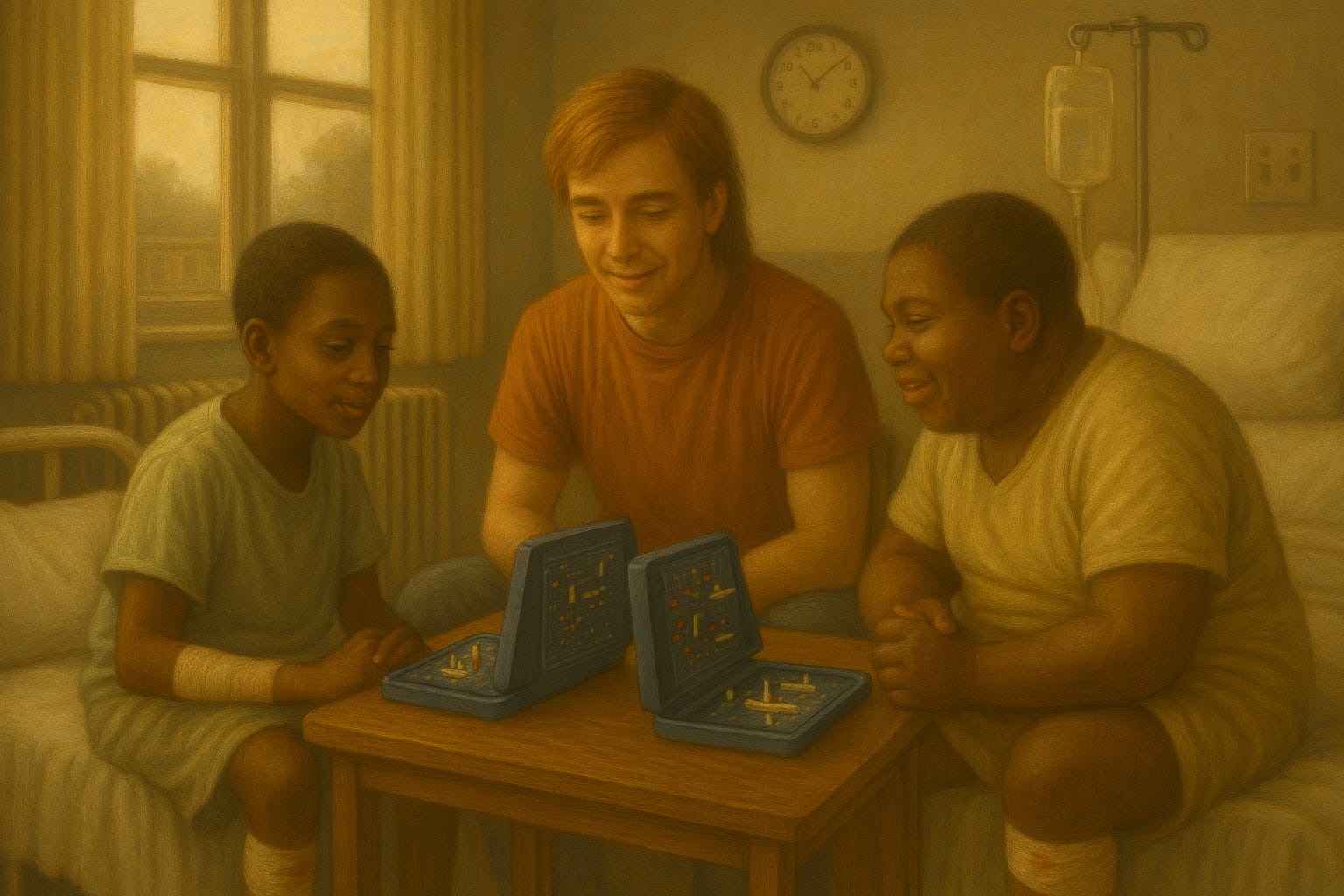
I played Battleships with Melvin and Albert who were hospitalized at Cook County Hospital in 1984.
In the shadows where I’d stumbled something had begun to shine. The semester abroad had nearly killed me. But in my unraveling, something unexpected took root. Gwynneth’s tea and presence had revealed to me a new way forward—not a map, but a lifeline. And breath, it turned out, was where my healing began. Emerging from the Underworld, I began the slow return to light—guided not by certainty, but by the steady rhythm of my own breath.
Healing began with children, games, and the quiet realization that showing up mattered. I had to restructure my winter term project. I reached out to the Child Life Services Department at Cook County Hospital to see if I could volunteer with the kids to explore pediatrics as a career path. The director gave me a book titled Play Therapy, which outlined how children can process illness and procedures through guided play. My winter term was set. I spent mornings in the lab and afternoons at Cook County Hospital on the pediatrics floor, working with their Child Life Specialist.
I had never been inside Cook County Hospital before then. The vast lower level was dark, teeming with patients and hospital workers, but sometimes also echoing with the clank of shackles from prisoners being treated under guard. But ascending to the second floor, the pediatric floor was bright and full of color, like the scene where Dorothy first encounters the land of Oz.
There, I met two boys, Melvin and Albert, both with sickle cell anemia and draining fistulas from bone infections. Both needed healing. Their pain was constant, but their playful spirit dominated. I was there to help.
I wasn’t sure what I was giving them, but I knew they were giving me a reason to stay and to play. We played board games—Battleship tournaments and long games of Monopoly—and I found it enough to be laughing and listening.
“What’s your name again?” Albert asked.
“Bill.”
“That’s boring,” he said. “You look more like a Lenny.”
“Lenny?”
“Lenny the Loser, the guy who always loses at Monopoly.”
“I’ve won two games in a row,” I protested, laughing.
Melvin, Albert and I played Battleships at Cook County Hospital.
“That’s just beginner’s luck. Wait till I get Boardwalk. Then you’re toast.”
We laughed, traded jabs, built tiny hotel empires, and argued over fake rent like it actually mattered. And in that moment, somehow, it did.
I’d read about survival in books. Here, I was living it—funny, fragile, real. These boys were survivors. But helping Melvin and Albert heal, in whatever little way I could, was helping me to heal.
One day, I was asked to help them put away the games because it was nearing dinnertime.
“Wait, wait, we’re not finished!” Melvin protested. He’d almost sunk Albert’s battleship.
“Can we play for just five more minutes?” Albert bargained.
“I don’t think so, Albert. It’s time to put this away. And face it, Melvin is about to sink your battleship!”
“Stupid honky!” he retorted.
“Don’t be mean, Albert!” Melvin stood up for me.
“No, man! Have you ever heard him blow his nose? He sounds just like a goose!”
I shrugged it off. Pain has its own language, and I was there to play and to support, not to judge.
Later, I visited Melvin at home in the South Side. His Sudanese family had beads hanging in their doorways instead of wooden doors. His mom eyed me warily. Even so, she gave Melvin money to take me out for fried rice at the Chinese restaurant around the corner. We ate on a bench overlooking the park. I gave him a stack of Hardy Boys books and my favorite picture book of natural history that my Grandma Anna had given me. Full of animal pictures, full of my childhood wonder.
Back in the lab, Don Braun asked me to join him for lunch. A one-on-one lunch with Don was unusual. Something was afoot. I found him in his office.
“Your dad said you were planning to travel around Europe. What happened?”
“Well . . . there were a lot of pressures. I was sick and feeling depressed, and then there was a date that ended in a complicated way. I was on the edge and did not handle things very well.”
I considered glossing over what had actually happened but instead decided to trust and confide in Don.
I laid out the whole saga.
“Bill, that sounds awful,” Don said, shaking his head. “You know what that was, right?”
“Humiliation?”
“No, a panic attack. I’ve had them too. Bad ones. The kind where you feel like you’re dying.”
I stared. “Wait—you? But you’re, like . . . normal.”
“Debatable,” he said with a grin. “It’s just a trick of biology. Like your body thinks there’s a saber-toothed tiger in the room but forgot to invite the tiger.”
I let out a long breath. “I thought I was broken.”
“You’re human. Maybe a human with overactive nerves. Welcome to the club. I wish we had T-shirts and a high-functioning support group, but we don’t—at least not yet.”
“Well, I have experienced these my whole life. And I hate them. I didn’t know they had a name!”
“There are ways to manage them,” he said, reassuringly. “Listen, I’ve got a secret weapon.”
He pulled a book off his cluttered bookshelf. “This book explains the fight-or-flight response and the calming effect of meditation. You ought to read it.”
“Thanks, Don. I totally appreciate this.”
Knowing someone as cool, self-assured, and successful as Don Braun had panic attacks like me was life-changing.
The book The Relaxation Response explained the biology of transcendental meditation. The techniques were developed by Maharishi Mahesh Yogi and involved the silent repetition of a sound or words. The book explained that meditation works best when practiced for fifteen to twenty minutes twice a day. The repetitive nature allows the mind to break free from destructive thought loops that trigger, or were triggered, by the fight-or-flight response. Instead, a parasympathetic response shuts off the fight-or-flight pathways.
Music and exercise could also provide benefits similar to meditation by forcing the mind out of destructive thought loops. This was all making sense to me, having lived much of my life experiencing the aftermath of negative thinking.
It wasn’t quick magic—it didn’t fix me right up—but it gave me something to hold onto when the current pulled too hard and the world started swirling.
Back at Oberlin, now in the second semester of my junior year, I moved into a closet-sized apartment on North Professor Drive. Kevin Kimata lived just next door. When I needed wisdom, or music and company, I knocked on his door.
My sister Alice had completed her first semester at Oberlin and was now a classmate. It was nice to have my adult sibling on campus, even if we ran in different circles. Having different friend groups, we experienced different dramas. She was smart, popular, and confident—far more certain of herself than I had ever been at her age. I admired her and quietly envied how naturally she seemed to belong.
My classes were challenging but manageable. I was taking Physics 101, Introduction to Philosophy, Introduction to Shakespeare, and Moons, Planets, and Meteorites—known on campus as “Rocks for Jocks.” Of all the courses, I loved studying the planets. We studied planetary geology, the formation of moons, and read from Scientific American. Images from recently launched probes brought close-ups of distant worlds. It sparked a lifelong wonder for the cosmos and a reflexive, almost religious, humility.
Most evenings, I studied at the library, inside giant plastic egg-shaped chairs that blocked out all distraction. When stress crept in, I meditated.
I started using Gwynneth’s simple mantra of four-count breathing, but over time, I found two mantras that I liked better. One was “He who acts as if they have faith shall be given faith,” from The Verdict, a movie about a lawyer struggling with alcoholism. In the film, Paul Newman plays a lawyer who chooses to fight for a woman whose sister was left in a vegetative state through medical malpractice. He, too, was deeply depressed but found his way in the movie. Maybe I could too.
Having recently concluded that I was agnostic, uncertain about the existence of a God that intervened in our day-to-day lives, I found it reassuring that if I did the right thing and acted as if I had faith, I would be given faith. I wanted to have faith.
The other mantra came from a beautiful African American spiritual song we sang in choir called “There is a Balm in Gilead”:
There’s a balm in Gilead to make the wounded whole. There’s a balm in Gilead to soothe my sin-sick soul.
In my meditation, I simply repeated the phrase “There is a balm in Gilead.”
Repeating this deeply religious mantra provided deep relaxation and sleep when I was hyperalert. A balm to my subconscious wounds and guilty feelings, perhaps?
Noting the benefit of exercise in preventing panic attacks, I also started training for a triathlon. I ran loops around the large field behind the field house, swam laps at the pool near the Cat in the Cream Coffeehouse, and rode a refurbished bike Kevin had tuned up, training every single day.
Eventually, I joined Kevin and others for the intramural water polo club, returning to a sport I’d loved so much in high school. John Parks, captain of the swim team, built nets from PVC pipe. We practiced at the old pool and eventually hosted a tournament with teams from Kenyon College and Denison University. I scored three goals—more than anyone on our team—and earned a strange, sudden respect from the swimmers.
That spring, Matt, Kevin, Ned, and I went on an adventure—seven days on the Allagash River in Maine, in canoes, dodging mosquitoes.
The Maine air was ripe with pine scent. The water, black and frigid, was clear. Moose chewing on reeds stepped peacefully through morning mist, oblivious to the water constantly flowing and warily eyeing us canoers slipping by. At night, loons called across the water like lost souls—or maybe like tenors who had gotten the goose.
We camped and cooked over fire. We saw a snake swallowing a frog—he literally had a frog in his throat. And we watched shooting stars in the infinite night sky.
No drama, no deadlines. Just four friends and the river. And silence—sweet, affirming silence.
Something started to open for me.
The Allagash carried me forward. Perhaps the Scylla and Charybdis were behind me, with Ithaca just around the bend. I had entered Oberlin as a pre-med, certain I’d follow in my father’s footsteps. But now I wasn’t so sure. I liked being outside. I liked being quiet and observing water flow, vast open skies, and the colossal mountains. I liked building fires more than cramming for tests.
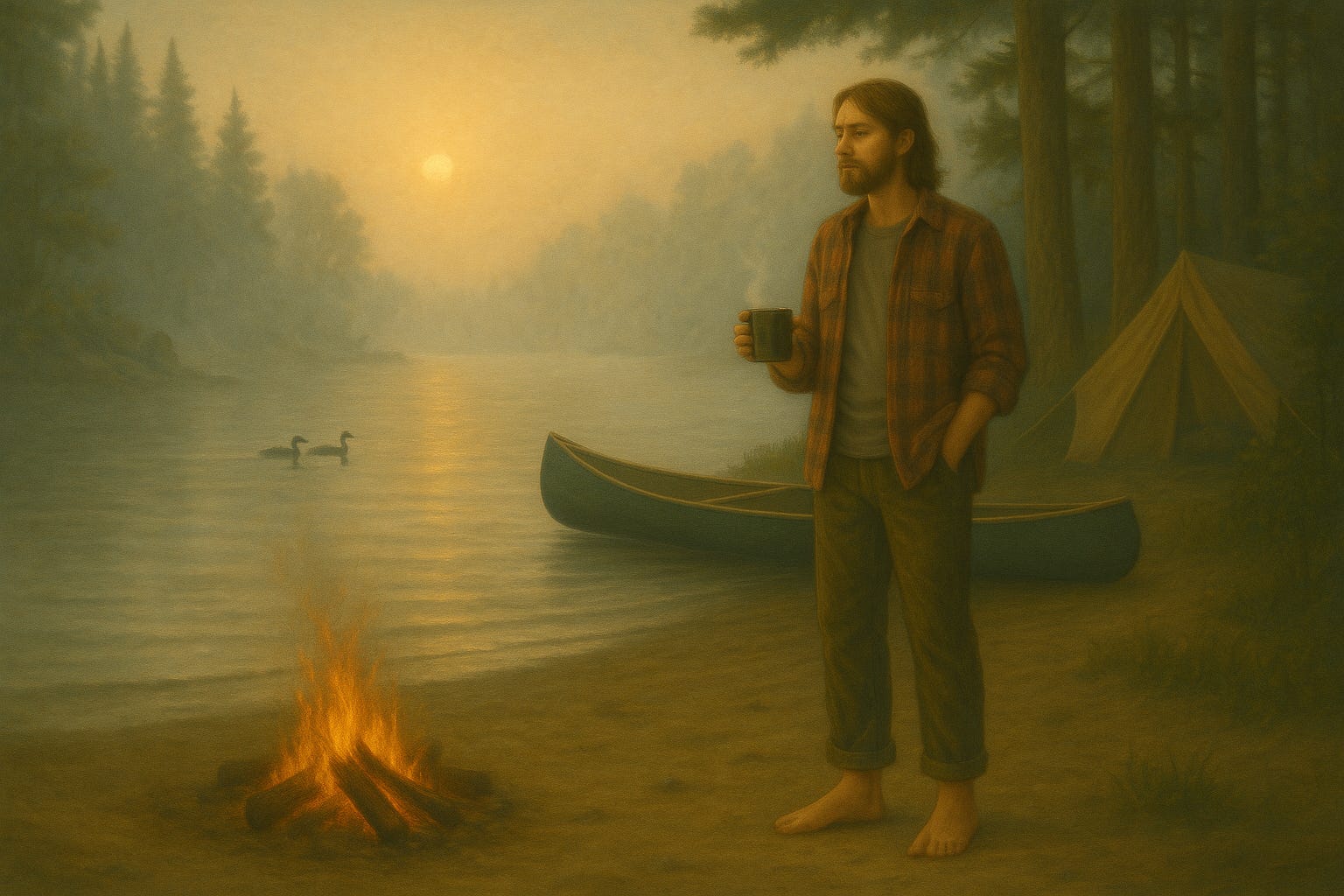
During the summer of our senior year we paddled down the Allagash River in Maine.
My brother, finishing at Brown, was deep in med school applications. I always admired him—but I wasn’t him.
Some of my classmates were cutthroat, driven by money and ego. That wasn’t me either.
Home for summer, I went back to work in the lab. I felt smothered.
Driving home with Dad in the Eisenhower traffic, we had a minor showdown.
“So, how’s your work going?”
“I feel like a rat in a cage. Bored, twitchy, and destined for a short life.”
“Well, that doesn’t sound good. It sounds like you’re unhappy.”
“I’m thinking of quitting.”
“Quitting?” He said on a long pause, “Bill, you’re the one who asked me to help you get that job.”
“I know. I appreciate it. But I struggle with the way I got the job. It’s nepotism.”
“Son, nepotism is not a dirty word. That’s how the world works.”
“Yeah, but . . . I want to see if I can make the world work without nepotism—on my own—without lab animals and pipettes.”
“Okay. What’s your plan?”
“I don’t exactly have one. But I thought about doing something with my music.”
“So instead of pipetting, you’ll be playing our viola?”
“Pretty much.”
Dad stared at the road, frowning. “Bill, I’m not trying to clip your wings. But music . . . it’s a hard life. There’s not a lot of job security in being a professional musician.”
“I’m not asking for security. I’m asking for meaning. I want to breathe.”
“You once told me you wanted to be an oncologist,” he said, his tone softening.
“I still might. I admire you so much. You do God’s work, Dad. But I don’t want to live your life if it means being miserable. I’m already too good at that.”
Dad sighed, rubbing his forehead with his free hand. “We’ve noticed. Your mom and I. We worry. But we believe in you. You’re not lazy, Bill—you’re searching. That’s different.”
“Thanks, Dad. I just want to find a path that doesn’t make me lose myself.”
“Fair enough. Just remember, medicine will always be there. And who knows, maybe you’ll come back to it with a stronger commitment. There’s nothing wrong with taking the long way home.”
That night, I went to a dinner at Brenda Wurman’s home. She had just returned from Japan, where she had been studying with the master violinist Shinichi Suzuki himself. At the dinner was Edmund Sprunger, a Suzuki violin teacher who worked at a music school downtown. I explained to him my woes working in the lab and how I wanted desperately to work somewhere else.
“Come work for us! We have a job as an administrative assistant. You would be working under our director, Ray Landers. He’s kind of intense—just warning you. But overall, it’s a great place to work.”
The following day I went downtown and interviewed for the job, and they hired me. My dad was shocked.
I spent the summer managing schedules and answering phones. Eventually, I played a central role organizing a weekend retreat in Lake Forest for Suzuki teachers from around the country.
Ray Landers was intense, extremely hard driving, and demanding, though in a good way. The kind of intense that made coffee nervous. Nevertheless, I worked well with him and had a fun, fulfilling summer. I appreciated the opportunity to begin again.
I was making decent money, and though the work was not so intellectually stimulating, the job was truly mine. I was living on my terms.
I enjoyed having lunch by The Art Institute and would often stop into a candy shop next to the music school to buy ice cream sandwiches—vanilla ice cream between two chocolate chip cookies. Identical triplet middle-aged women with jet black hair and cherry red lipstick worked the counter and greeted me with the same bright smile. One of them would hand me my frozen joy each day. And I didn’t know which!
I ended the year with my mind and heart in different places. Medicine still loomed, but so did something wilder, more open-ended. I didn’t have the answer yet. But I had survived the hardest season so far, discovered the quiet power of meditation, and learned what it felt like to make a child laugh through pain.
That felt like something. That felt like a beginning.
I was venturing into new territory. I wasn’t sure I wanted to be a doctor. Medicine was still in the picture—but so were the loons, and the laughter, and the light in a child’s face when pain briefly let go. I didn’t have a map, but I had wrested control of my ship. And I realized how much I liked to help kids.
Maybe it was lunacy. I still didn’t know my destination. But I knew this much—I had survived the abyss. And the paddle was in my hands.
I felt a little stronger. I had a lifeline. A thread. A breath. A new beginning.