
Chapter 18: Panacea
“Courage is being scared to death . . . and saddling up anyway.” — John Wayne

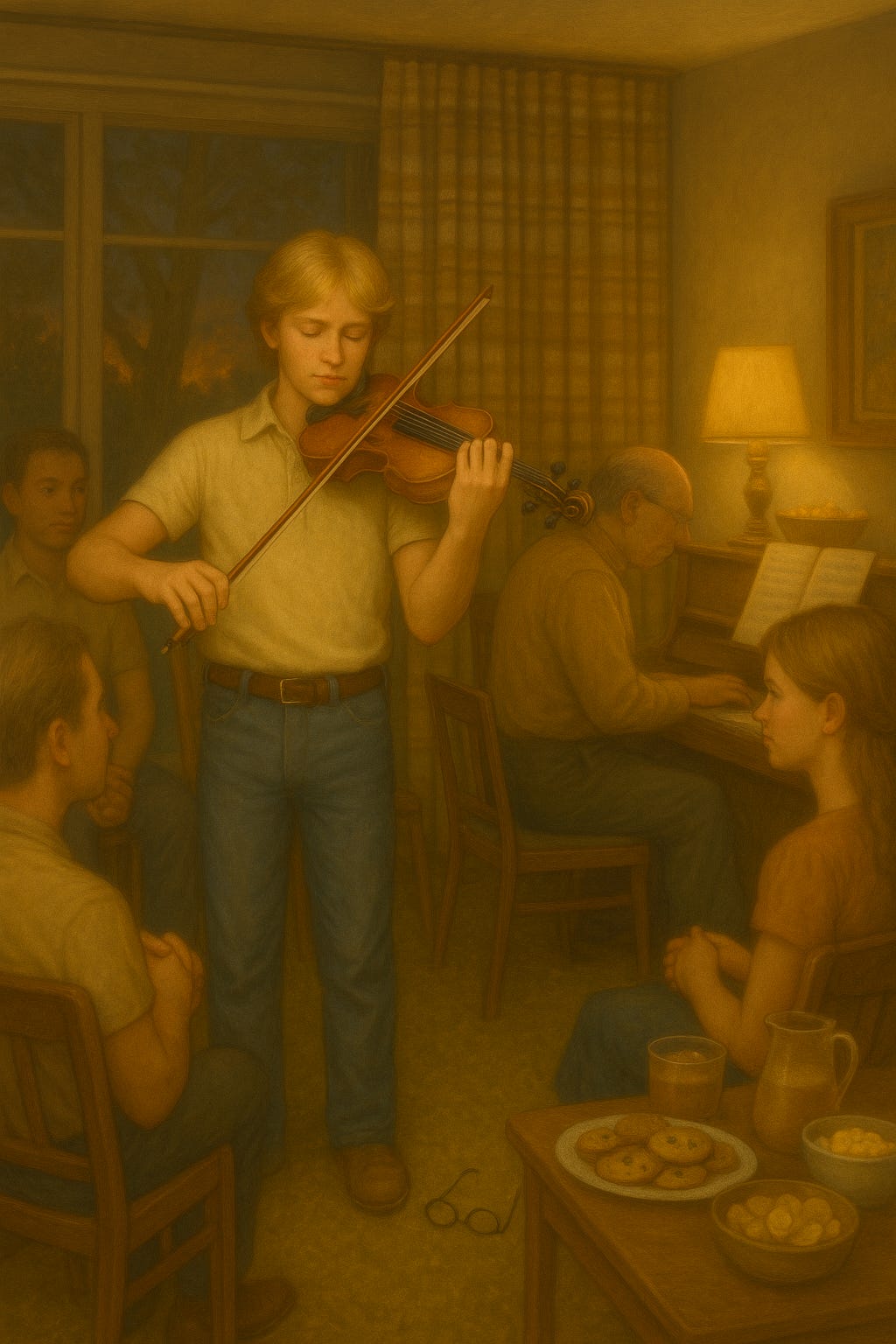
I overcame stage fright and had my first viola recital during my sophomore year.
Just when I thought I’d mastered the art of balancing swim meets, orchestra rehearsals, and the occasional existential crisis, junior year moved swiftly like a raft encountering unexpected rapids. If freshman year was about discovering the river, and sophomore year was learning to paddle, then junior year was the part where you realize the river has whitewater—and you’re in the rapids, holding a viola instead of a paddle. It was a time of growth, missteps, and the kind of awkward self-discovery that makes you cringe and chuckle in hindsight. As I stood on the precipice of adulthood, I was navigating the murky waters of adolescence, one humorous misadventure at a time.Even today, junior year of high school is no joke for kids in AP classes. Back in 1980, my junior year was brutal. I was juggling AP Physics, AP American History, and varsity water polo. Somewhere in that chaos, I made a boneheaded mistake that had less to do with what I actually did and more to do with my awkward desire to belong.
Cheech & Chong, an irreverent comedy team, were everywhere back then. Tommy Marlin introduced me to them—he’d heard their skits on WLS radio. “Sister Mary Elephant” was the big one. “Class . . . class . . . class . . . Shut up!” We’d echo it endlessly like it was holy scripture.
For Christmas in 1973, I bought the Cheech & Chong album Big Bambu for my seven-year-old sister Alice. But really, I wanted it for me. I had no clue that Big Bambu was a brand of rolling paper for smoking marijuana. The album cover was a parody of the brand’s packaging, complete with oversized faux rolling paper inside. Most of the album flew over both of our heads—its jokes about sex and drugs were adult in ways we didn’t at all understand.
We opened it together in front of my aunt, who was visiting. Proud of this gift I had given Alice as much for me as for her, I fired up the stereo and dropped the needle on Herbie and Ralph, a tale of two dogs who describe having a bowel movement and their love for a poodle named Fifi who was in heat. It was crass. Alice loved it! My aunt, to her eternal credit, didn’t blink. My mom didn’t say a word. She also never listened to the rest of the album. I, of course, did.
Fast forward five years—even as a high school student, there were a lot of things on that album that I knew nothing about from personal experience. The guys on the water polo team loved Cheech & Chong. They parroted it a lot. They loved the part where the dog Herbie compared Ralph’s bowel movement to a masterpiece by Rembrandt.
After practice, you’d hear this line echo from one of the bathroom stalls: “Aw, man, it looks like a Rembrandt!” A satisfied artist, proud of his work.
Someone else would reply, “Better not step in it.”
We’d crack up every time like it was the first time we had heard it.
Later that year, after a water polo game, I was riffing with a teammate on a bit from “Let’s Make a Dope Deal,” a spoof of the TV game show Let’s Make a Deal.
“How many joints are in a lid?” my teammate started the riff, asking me as if I were a game show contestant.
“One,” I responded. (The real answer is around ten.)
“One?” he asked.
“I roll big joints,” I said.
Coach overheard us. Later, he approached me and said, “Billy, I’m worried about you.”
“What? Why, Coach?” I asked.
“Heard you talking about rolling joints on the bus.”
“Oh, that was from Cheech & Chong. It’s a joke.”
He didn’t smile. Instead, he gave me a stern look and said, “Billy, that’s how it starts. A joke leads to a joke. A toke to a toke. A snort to a snort. What starts with you rolling with your friends can turn into your life rolling off a cliff.”
I nodded in understanding but it hurt. Thinking of it triggered pangs of guilt, a tightness in my chest and stomach. I had been working hard and improving. What a waste! I figured I would be benched and I was.
I honestly had no idea what I was talking about. I’d just been parroting lines to feel like I belonged. Still, Coach made an example of me. I lost playing time for the next three games. It made me sad, but I accepted my punishment.
Around that time, I started noticing pain in my lower back. Dad took me downtown to get checked out. The X-rays showed a defect in my lower vertebrae—Scheuermann’s disease. The undulating kick of butterfly stroke only made it worse. Heading into swim season, it felt like another blow.
When I told Coach Locke, he just nodded. “Rest up, and take care of yourself, Billy,” he said. And that was it.
Swimming had been central to who I was. I was tall now, shoulders broadened by endless laps, my hair bleached blond by chlorine. Many of my closest friends were swimmers. I loved water polo, but the hundred-yard butterfly and long-distance freestyle were becoming painful and exhausting. The truth was, I couldn’t keep competing.
Oddly, mixed with disappointment came relief. Between the heavy class load, the water polo benching, and the constant pain, swimming had become more burden than joy. My backache from overuse was my escape. It gave me a way out of a grueling time sink. Losing the sport hurt, but like many things in life, it also opened a magic door—more time for studying, and more time for making music.
That spring, Mrs. Wurman suggested I commit to memory the entire first Bach Cello Suite—an intricate, spiraling masterpiece. I buried myself in it. The music was both technically demanding and spiritually calming. Day by day, practice shifted from duty to devotion. Playing became meditation; it cleared my mind.
Then Mrs. Wurman proposed something radical—a recital.
Playing in a group was one thing. But alone? My hands would lock, my heart would pound, and panic would take over. To prepare, she had me rehearse with her husband at the piano. His hands trembled until they touched the keys. Then, as if under a spell, the shaking ceased.
I was sensing the gravity of someone who had endured unimaginable fear as a Holocaust survivor, yet found refuge and healing in music. His steadiness at the keyboard was a lesson in itself—music overruling memory and fear, music flowing through his body until even the tremor yielded.
Alongside Bach, I would play Schumann’s Adagio and Allegro and Beethoven’s Romance, pieces that breathed with his accompaniment.
I admitted my terror.
“You should try Inderal,” he said.
“Inderal?”
“It’s a beta blocker. Many musicians use it—for nerves, for this sort of tightness.”
My dad had been there for the lesson. On the way home, we talked. I didn’t like the idea of taking medication just to play. But Dad had heard of Inderal, also known as propranolol too—used for stage fright.
“Might be worth keeping an open mind,” he said.
Eventually, I tried it. And I said yes to the recital.
After months of practice, the day came. Our living room was transformed into a concert hall, full of friends from the Wurman studio and their families. Mom laid out a spread worthy of a holiday—apple kuchen, chocolate chip cookies, onion dip, and Ruffles. She even had a delicious pineapple sherbet punch, a recipe my mom borrowed from Jim’s music teacher’s husband.
This was my first public performance since getting the yips playing St. Louis Boogie in Mrs. Emerick’s studio. Approaching a major threshold.
I opened with the first Bach Suite. As I began bowing the opening prelude, I felt surprisingly calm. Level. The Inderal was working. The notes unfurled like ripples across a pond—layered and deep, building toward the emotional swell at the end.
Then I started sweating. My glasses slipped. I scrunched my face, but it was no use. They slid down and—clunk—hit the strings and bounced to the shag carpet with a little twang.
I kept going.
Didn’t miss a beat.
When I finished, everyone applauded.
“Sorry. I didn’t mean to make a spectacle of myself,” I joked, channeling my inner dad.
My friend’s dad—who had been filming my performance—burst out laughing, right into the tape recorder. My pun and his cackle live on, captured forever on that magnetic tape.
I played my heart out that night. The fear had shrunk, the joy had grown, and when the last guest left, my dad turned to me and said simply, “I’m so proud of you.”
I blinked, surprised and unsure how to respond.
“Even when your glasses went rogue, the music kept flowing.”
“Well, technically, I didn’t maintain eye contact, at least when it came to my glasses,” I quipped.
He laughed and gave me a brief but gloriously warm hug.
Something good lit up in my chest, spreading through my limbs. Not the Inderal—something better. Something real.
Later that night, as sleep overtook me, I slipped into a dream.
My dad and I were together on a small sailboat, gliding down a sunlit shore at golden hour. The sail above us wasn’t cloth—it was a musical score, shimmering with notes and staves that danced in the breeze. A harmonious breeze carried us forward, steady and sure, filling our sail, lifting us onward. We didn’t need to speak. The gentle force of music—of family and love, of all we had shared—moved us effortlessly along.
And for the first time in a long time, I didn’t feel anxious or lost. I felt carried. Connected. Free.
The music, the love, and something emerging, newly strong inside me, carried me forward. The knowledge that I could perform.
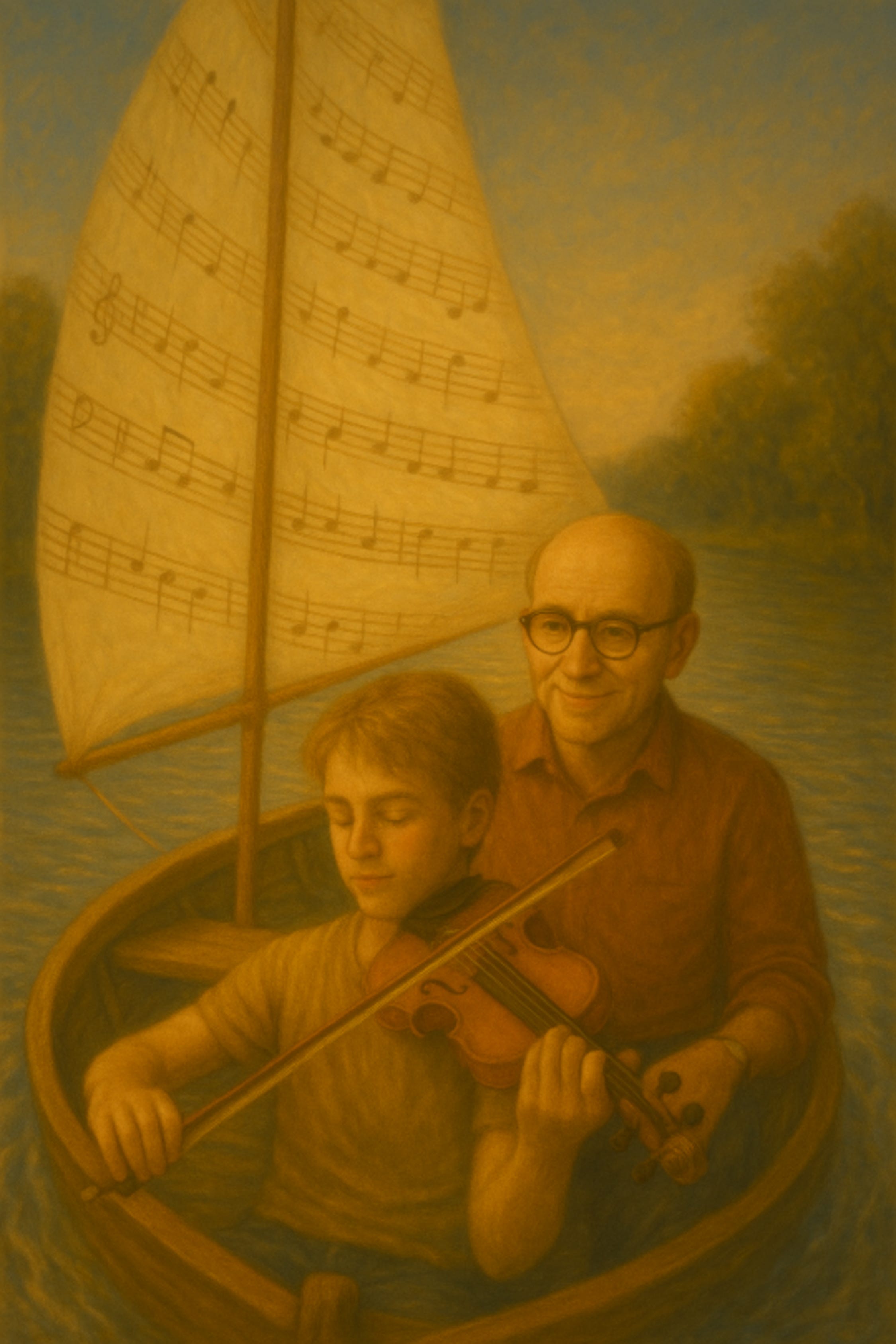
I dreamt of sailing with my dad, propelled by music in our sails.
Such a beautiful image, the picture and especially the words. Being a teenager is such a roller coaster and you capture it all so well.
I felt that pain. It's so difficult when something gets taken out of context or becomes something it was never meant to. I enjoyed this very much. And, Cheech and Chong? Legends!